Lost foam casting offers a different approach to producing complex metal components by using an expandable polystyrene (EPS) foam pattern that evaporates during metal pouring. The process can reduce the need for conventional cores and parting-line constraints while supporting intricate geometries and near-net-shape components.
As a lost foam casting manufacturer and supplier, Mahadev Ferrocast uses the process for component requirements where geometry, dimensional consistency, reduced machining, and manufacturing efficiency need to be considered together.
Years of Foundry Experience
Lost Foam Components Manufactured
Lost Foam Casting Projects Completed
Satisfied Customers
When Lost Foam Casting Makes Sense for a Component
Lost foam casting is particularly useful when conventional moulding and core arrangements make a component difficult or expensive to produce. Because the foam pattern reproduces the component's geometry directly, the process can support complex shapes, internal features, and integrated sections.
It can be considered when a component requires:
Complex geometry
Intricate external or internal features that are difficult to reproduce through conventional moulding.
Reduced core dependency
Geometries that would normally require multiple cores can potentially be produced without conventional core assemblies.
Near-net-shape production
Components where reducing material removal after casting can improve manufacturing efficiency.
Fewer parting-line constraints
Components where parting lines, flash, or mould/core assembly can complicate the finished geometry.
Integrated features
Multiple features or sections that can potentially be consolidated into a single cast component.
Repeatable component production
Applications where a dedicated foam pattern can support recurring production requirements.
Our Lost Foam Casting Process
At Mahadev Ferrocast, as a lost foam casting manufacturer, we plan our lost foam casting process around the geometry and finished-component requirements rather than treating pattern production and casting as separate activities.
Pattern Development
The component geometry is translated into a foam pattern designed to reproduce the required casting form.
Pattern Assembly & Preparation
Where the component requires multiple pattern sections, these can be assembled into the required configuration before mould preparation.
Refractory Coating
The foam pattern is coated to provide a controlled interface between the pattern, sand, and molten metal while supporting the required casting surface quality. Coating permeability is an important process consideration because gases generated during foam vaporisation need to escape during pouring.
Sand Moulding
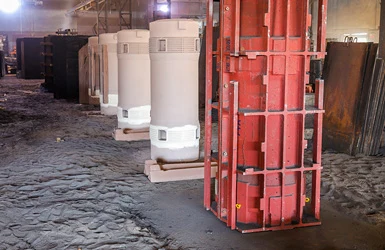
The coated pattern is placed in a flask and surrounded with unbonded sand. Controlled compaction supports the pattern geometry while maintaining the required mould structure.
Metal Pouring
Molten metal is introduced into the mould. The heat vaporises the foam pattern as the metal progressively occupies its shape.
Shakeout & Finishing
After solidification, the casting is removed from the sand, separated from the gating system, and taken through the required finishing operations.
Machining & Inspection
Where required, machining and inspection are carried out against the finished-component dimensions, tolerances, and quality requirements.
Share your component geometry and specifications to evaluate the right lost foam manufacturing approach.
Manufacturing Benefits of Lost Foam Casting
At Mahadev Ferrocast, we evaluate lost foam casting not only for its ability to reproduce complex geometries but also for the manufacturing advantages it can offer across tooling, machining, assembly, and overall component production.
Reduce Core-Related Complexity
Lost foam casting can eliminate or reduce conventional core requirements for components with complex internal features, simplifying mould preparation and pattern development.
Minimize Post-Casting Machining
The near-net-shape nature of the process can reduce material removal after casting, particularly where the required component geometry can be closely reproduced through the foam pattern.
Integrate Multiple Features
Complex features, sections, and geometries can be incorporated into a single casting, potentially reducing the number of separate components and subsequent assembly operations.
Manufacture Complex Geometries
The foam pattern can be developed around intricate component geometry, allowing us to address shapes that may be more difficult to produce using conventional mould and core arrangements.
Improve Overall Manufacturing Economics
For suitable components and production volumes, reduced core requirements, machining, tooling complexity, and assembly can contribute to a more efficient overall manufacturing route.
Lost Foam Cast Components for Industrial Applications
Our lost foam cast components are best suited to applications where component geometry and manufacturing complexity justify the advantages of lost foam casting.
Potential applications include:
Pump & Valve Components
Complex housings and flow-related components
Motor & Machinery Components
Housings and structural cast components
Automotive & Engineering Components
Components requiring complex geometry and feature integration
Transmission Components
Components with integrated features and complex geometry
Industrial Equipment
Machinery components requiring repeatable production
Specialised Cast Components
Drawing-based components with application-specific geometry
Why Choose Mahadev Ferrocast as a Lost Foam Casting Manufacturer?
As a lost foam casting supplier, Mahadev Ferrocast focuses on more than process capability alone. The value comes from translating the component requirement into a controlled casting and finished-part manufacturing route.
Component-Focused Evaluation
We assess the component's geometry, material, production requirements, machining needs, and application before establishing the manufacturing approach.
Integrated Manufacturing Support
Pattern development, casting, finishing, machining, and inspection can be coordinated around the finished component.
Experience Across Ferrous Castings
Our broader foundry experience supports material and process considerations when our lost foam casting manufacturing capability is evaluated for an industrial component.
Focus on Repeat Production
The process is planned not only for the first successful casting but also for the consistency required in recurring industrial supply.
Manufacturing Around Customer Specifications
Drawings, tolerances, material requirements, quantities, and application conditions provide the basis for determining the appropriate manufacturing route.
Develop Complex Components with Lost Foam Casting
Share your component drawing, 3D models, material requirement, approximate weight, quantity, and machining requirements with our team.
We can evaluate the geometry and discuss whether our capabilities as a lost foam casting supplier are appropriate for your component.
FAQs
What types of components are suitable for lost foam casting?
Lost foam casting is particularly suitable for components with complex geometries, internal features, integrated sections, or designs where conventional core arrangements can add manufacturing complexity.
Can lost foam casting reduce machining requirements?
Yes. The process can produce near-net-shape components with complex features, which can reduce the amount of material requiring removal after casting when the design and process are appropriately developed.
Does lost foam casting require conventional cores?
One of the key advantages of the process is that certain geometries that would normally require conventional cores can be produced directly through the foam pattern. The extent of core elimination depends on the component design.
What information is required to evaluate a lost foam casting component?
A component drawing or 3D model, material specification, approximate weight, production quantity, application, dimensional requirements, and machining details provide a useful basis for evaluating the process.
Is lost foam casting suitable for every component?
No. Suitability depends on factors such as component geometry, material, size, production quantity, dimensional requirements, pattern complexity, and overall manufacturing economics.
Can lost foam cast components be machined after casting?
Yes. Where finished dimensions, tolerances, or interfaces require machining, lost foam castings can undergo the required secondary machining operations. The process may also reduce machining requirements for suitable geometries.