When component performance calls for higher strength and toughness than conventional grey iron can provide, ductile iron casting manufacturers can offer a material solution suited to demanding industrial applications.
Mahadev Ferrocast manufactures ductile iron components for equipment and machinery where load-bearing capability, durability, machinability, and dimensional requirements need to work together.
Years of Ductile Iron Manufacturing
Ductile Iron Components Supplied
Export Markets Served
Tonnes Annual Capacity
Why Choose Ductile Iron for Industrial Components?
The nodule-shaped graphite structure of ductile iron, also known as nodular cast iron, provides distinct performance advantages over grey iron, making it suitable for components subjected to increased loads, high impact, and continuous operating stresses.
Enhanced durability
For parts that must bear greater mechanical loads and operating demands.
Toughness
More resistant to impact and breakage than standard grey iron.
Weight bearing capacity
Suitable for demanding uses in which the rigidity and longevity of the component are critical.
Design adaptability
Casting enables the manufacturing of intricate geometry and integrated characteristics with the necessary material properties.
Machinability
Ductile iron can be machined to achieve required dimensions, interfaces, and surface requirements.
Grade flexibility
Different ductile iron grades allow material properties to be matched to the component's operating requirements.
Our Ductile Iron Manufacturing Process
At Mahadev Ferrocast, the ductile iron casting process is approached as part of the finished component rather than an isolated manufacturing step. Material selection, casting, finishing, machining, and inspection are coordinated around the component's specifications and application requirements.
Component & Specification Review
We begin by reviewing customer drawings, material requirements, component geometry, quantities, and application conditions to establish the manufacturing requirements.
Material & Process Planning
Based on the defined requirements, the appropriate ductile iron specification and casting approach are determined according to the component's mechanical properties, dimensional requirements, and application needs.
Casting
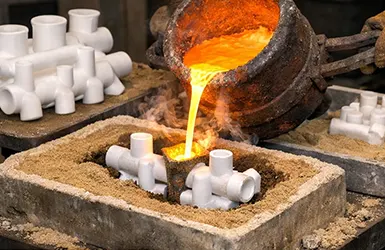
Once the material and process are established, the component is produced through the selected moulding and casting process, with relevant material and process parameters controlled throughout production.
Finishing & Preparation
Following casting, fettling, shot blasting, and other required finishing operations prepare the component for inspection or further processing.
Machining
Where machining is required, the finished casting is processed to achieve the specified dimensions, tolerances, mounting surfaces, and component interfaces.
Inspection
Finally, the completed component is inspected against the applicable material, dimensional, and quality requirements before moving to supply.
Bring Your Ductile Iron Component to Production Share your drawing and requirements with our team to discuss the right manufacturing approach.
Ductile Iron Grades & Material Specifications
Ductile iron is available in grades with varying levels of strength, elongation, toughness, and other mechanical properties. The grade is selected based on the loading state of the material, usage conditions, geometry and performance criteria.
Mahadev Ferrocast can work with applicable EN, ASTM, and IS specifications, based on the required material grade and component requirements.
| Component Requirement | Material Consideration |
|---|---|
| Higher mechanical loads | Grade selected for the required strength |
| Impact or demanding operating conditions | Grade selected for suitable toughness and elongation |
| Machined components | Material characteristics considered alongside machining requirements |
| Application-specific performance | Specification aligned with the component's operating conditions |
*Exact grades and mechanical properties can be added based on our verified technical data.
Ductile Iron Casting Quality & Inspection
Our quality checks are integrated across the ductile iron manufacturing process to ensure the finished component meets its defined material, dimensional, and mechanical requirements.
Quality evaluation includes:
Material Composition
We verify the material composition against the specified ductile iron grade and requirements.
Mechanical Properties
Required mechanical properties are evaluated against the applicable material specification.
Casting Condition
Cast components are checked for surface condition, casting defects, and other defined casting quality requirements.
Dimensional Accuracy
Critical casting dimensions are inspected against the approved component drawing.
Machined Dimensions
Where machining is specified, finished dimensions, tolerances, and component interfaces are verified.
Application-Specific Checks
Additional inspection or testing can be incorporated where required by the component specification or application.
Ductile Iron Components for Industrial Applications
As a ductile iron components manufacturer, Mahadev Ferrocast manufactures cast components for equipment where strength, toughness, dimensional accuracy, and service reliability are important.
Pumps & Valves
Components requiring strength, dimensional accuracy, and reliable service performance
Gearboxes & Transmission Equipment
Components exposed to mechanical loads and repeated operation
Elevator & Traction Equipment
Components requiring structural strength and durability
Road-Making Equipment
Heavy-duty components for demanding operating conditions
Industrial Machinery
Components requiring a balance of strength, toughness, and machinability
Engineering Equipment
Application-specific components manufactured to defined requirements
Why Choose Mahadev Ferrocast as a Ductile Iron Casting Exporter?
Selecting a ductile iron casting partner is not simply about finding out if a manufacturer can make the material. The supplier is also expected to know the specifications for the component's performance and to uphold them in manufacturing.
Material-Application Understanding
We evaluate ductile iron requirements around the component's mechanical properties, operating conditions, geometry, and intended application.
Manufacturing Under One Setup
Foundry, finishing, machining, and inspection capabilities allow different stages of component production to be coordinated through one manufacturing partner.
Support for Complex Requirements
Ductile iron components can involve demanding geometries, material specifications, machining requirements, and dimensional expectations. Manufacturing is planned around the defined component requirements.
Consistent Repeat Production
For industrial buyers with recurring requirements, established manufacturing processes support repeat component production against defined specifications.
Specification-Driven Supply
Customer drawings, material requirements, quantities, and quality expectations provide the basis for manufacturing rather than a standard one-size-fits-all approach.
Discuss Your Ductile Iron Casting Requirement
Looking for a reliable ductile iron casting supplier for an engineered component?
Share your drawing, material specification, quantity, or application requirements with our team to discuss the appropriate manufacturing approach.
FAQs
What is the difference between ductile iron and grey iron?
Ductile iron generally provides higher strength and toughness, while grey iron is known for properties such as machinability and vibration damping. The appropriate material depends on the component's operating and performance requirements.
Which ductile iron grade is suitable for my component?
Grade selection depends on factors such as required strength, elongation, hardness, loading conditions, operating environment, and application. The appropriate specification can be determined from the component requirements.
What factors affect the cost of ductile iron castings?
Cost depends on material grade, component weight and complexity, tooling, production quantity, machining, finishing, and inspection requirements. Final pricing is determined according to the specific component and production scope.
How long does ductile iron casting production take?
Lead time depends on component complexity, tooling requirements, material specification, quantity, and secondary processes. First-time components may require additional time for tooling and process validation.
Can ductile iron castings be manufactured to EN, ASTM, or IS standards?
Yes. Ductile iron castings can be manufactured to applicable EN, ASTM, and IS specifications, depending on the required grade and component requirements.
What information is required to request a quotation?
A component drawing or 3D model, required material grade, quantity, application details, and machining or finishing requirements can help evaluate the component and determine the manufacturing scope.